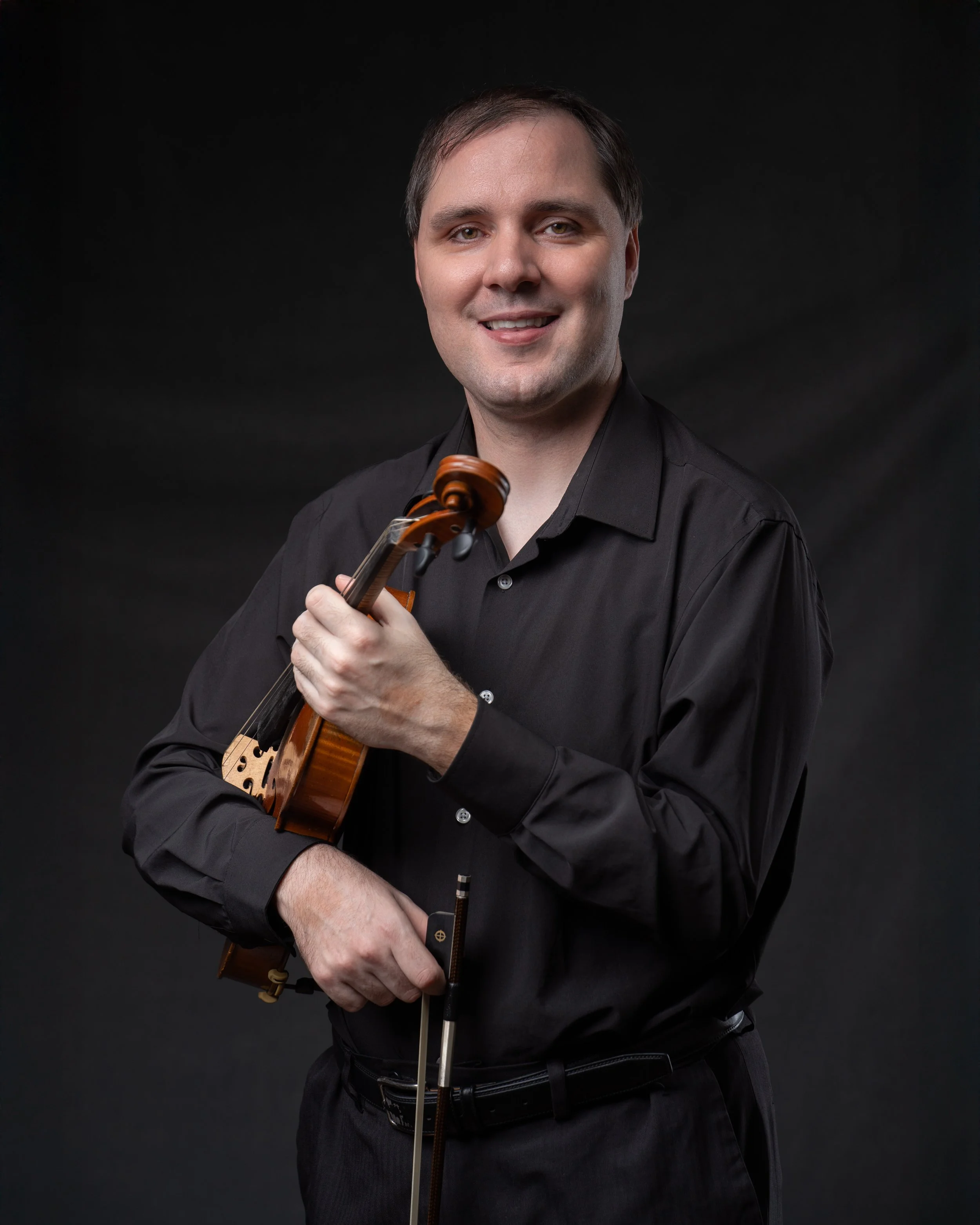
Originally from Wilmette, IL, north of Chicago, Richard Bruner has been a musician his whole life. He started violin lessons at age 3, and piano lessons at 6. He has added many other instruments over the years. He wrote his first tune at age 8 and had his first premiere in 8th grade when members of his Jr. High orchestra performed his String Quartet No. 1 in A minor. Richard attended New Trier High School in Winnetka, IL, playing in the acclaimed New Trier Symphony Orchestra, as well as studying music theory (among other things!). He also earned Eagle Scout through the Boy Scouts of America, leading a 12-piece ensemble of fellow scouts and friends in two concerts mostly of music he composed or arranged at Chicago-area retirement homes for his service project.
Richard attended the Berklee College of Music in Boston, MA, majoring in film scoring with a minor in acoustics and electronics. He chose violin for his principal instrument, playing in the Berklee Contemporary Symphony Orchestra as well as over 60 student film scoring recording sessions in addition to conducting his own. He graduated summa cum laude in 2012.
After graduating from Berklee, Richard moved out to Los Angeles, CA, where he currently lives pursuing a career in music for media and music in general. He has worked as a music library manager, having helped run operations at the Chicago Music Library in Encino, CA for several years ending as its Director of Operations and then serving as the Chief Operating Officer for KQM Entertainment Group, organizing the launch of their production music library, KQM Production Music.
Richard earned his Master of Music degree in composition in 2025, graduating with distinction from California State University, Northridge. He studied with Dr. Patrick O’Malley and Dr. Liviu Marinescu, ultimately producing his recital Between Worlds: Multi-Genreism in Music, leading a septet of strings and piano. While there, he also worked as a department music theory / musicianship tutor for the undergraduate students.
Richard now offers composition lessons, music theory / musicianship tutoring, and music production training, both in person in Los Angeles (particularly the San Fernando Valley), and online. See the Teaching page for more information.
He composes orchestral and chamber music as well as electronic music and folk music arrangements. His orchestral works have been premiered by the Symphony of the Verdugos and the Pasadena Community Orchestra. He also works as a freelance music preparation specialist for both film score recording sessions and concert music, as well as lead sheet transcription.
Richard is an active performer, playing regularly with the Symphony of the Verdugos and San Fernando Valley Symphony Orchestra (at both of which he is principal viola), the Topanga Symphony Orchestra, and the Crown City Symphony, along with freelance concerts and recording sessions around town. He has also performed on viola with the Pasadena Community Orchestra and the Civic Orchestra of Los Angeles as well as the CSUN Symphony Orchestra while working on his master’s degree.
In addition to his classical performances, he also plays fiddle and tin whistles with the Scottish Fiddlers of Los Angeles, and his tunes have placed multiple times in the national Scottish F.I.R.E. composition competition, taking 1st place in 2025 for the air “Petrichor”. See the Tunebook page for more information. Richard’s tunes and arrangements have been performed by the Scottish Fiddlers of Los Angeles, and he is an associate director of the group for the 2025-2026 season.
You can find and purchase Richard’s sheet music at Scoreexchange.com, and audio demos (both live and synthesized) at his SoundCloud profile as well as on this website. Please get in touch if you want to talk to Richard about anything!
Find Richard’s resume here: Full (3-page), Condensed (1-page)
Richard has been writing up his personal musical philosophy under the name “Capital-M Music”, a project which has grown to include several sub-components over the past several years. Find the original paper here, and all the writing under the Teaching/Writing tab above.

Instrument List
Primary instruments:
Classical Violin / Celtic Fiddle (Irish, Scottish, etc) - 4-string and 5-string violin
Viola
Tin Whistles (variety of models and keys)
Set of Recorders (Sopranino, Soprano, Alto, Tenor)
Hammered Dulcimer
Other Instruments:
Piano
Acoustic and Electric Guitars
Mandolin
26-string Irish Lap Harp
Irish Flute
5-string open-back Banjo
Ukulele
10-string Kantele
Bodhran (Irish frame drum)
Additional hand percussion
Studio Technology
Computer: Mac OS X, Windows 10 (with touch support)
DAW/Sequencers: Logic Pro 12 (Apple Creator Studio), Steinberg Cubase 14 Pro, Bitwig Studio 6
Notation: Steinberg Dorico 6 Pro, Avid Sibelius Ultimate
Sample Libraries / Synthesizers: Too many to count, but including -
Native Instruments Komplete 15 Ultimate Collector’s Edition, Arturia V-Collection 11 (+ Pigments), Applied Acoustic Systems Modeling Collection, Xfer Records Serum 2, Spectrasonics Omnisphere 2, Wallander Instruments Note Performer (for notation software), Audio Modeling SWAM Woodwinds and Brass (and EWI Solo wind controller), Synful Orchestra, Modartt Pianoteq 9 and Organteq 2, Garritan Libraries (Personal Orchestra, World Instruments, Pipe Organs), epic percussion from 8dio, Soundiron and InSession Audio, and more

Orchestral Repertoire Highlights
I’ve been playing in orchestra for a long time now, and have performed quite a bit of the standard orchestral repertoire on 1st violin, 2nd violin or viola. Please click here for a more complete list (broken out by instrument), but some highlights include:
Bach, J.S.:
Concerto for Two Violins (2nd Violin Solo)
Violin Concerto in A Minor
Brandenburg Concerto No. 3
Orchestral Suite No. 2
Orchestral Suite No. 3
Beethoven:
Symphonies 1, 2, 3, 5, 7, 8
Egmont Overture
Violin Concerto
Choral Fantasy
Bizet:
Carmen Suites 1+2
Brahms:
Symphonies 2,4
Piano Concerto No. 1
Violin Concerto
Double Concerto for Violin and Cello
German Requiem
Copland:
Appalachian Spring
Lincoln Portrait
Rodeo
Debussy:
Prelude to “The Afternoon of a Faun”
Dukas:
Sorcerer’s Apprentice
Dvorak:
Symphonies 6, 7, 8, 9 (“New World”)
Elgar:
Enigma Variations (Complete)
Enescu:
Romanian Rhapsody No. 1
Haydn:
Symphonies 103 (“Drumroll”), 104
Holst:
The Planets (complete)
Mahler:
Symphony No. 1 in D Major
Mendelssohn:
Symphonies 3 (“Scottish”), 4 (“Italian”), 5 (“Reformation”)
Violin Concerto
Mozart:
Magic Flute (Complete staged opera)
Symphonies 39, 40, 41 (“Jupiter”)
Requiem
Mussorgsky:
Pictures at an Exhibition (orch. Ravel)
Night on Bald Mountain (orch. Rimsky-Korsakov)
Prokofiev:
Symphony No. 1 “Classical”
Rachmaninoff:
Piano Concertos 2, 3
Revueltas:
Sensemaya
Rimsky-Korsakov:
Capriccio Espagnol
Rossini:
Overture to “William Tell”
Overture to “La Gazza Ladra”
Saint-Saens:
Bacchanale from “Samson and Delilah”
Danse Macabre
Schumann:
Symphonies 3 (“Rhenish”), 4
Schubert:
Symphony No. 8 in B Minor “Unfinished”
Sibelius:
Symphony No. 2 in D Major
Violin Concerto
Shostakovitch:
Symphony No. 5
Stravinsky:
Firebird Suite (1919)
Suppe:
Light Cavalry Overture
Tchaikovsky:
Symphonies 1,2,5
Romeo and Juliet Overture
Violin Concerto in D Major
Vivaldi:
The Four Seasons (Complete)
Wagner:
Overture to “The Flying Dutchman”
Overture to “Die Meistersingers von Nurnburg”