Glendale Community College
Music Department European Tour Summer 2026
Final Reflection Essay
Richard Bruner
Composer and Principal Viola
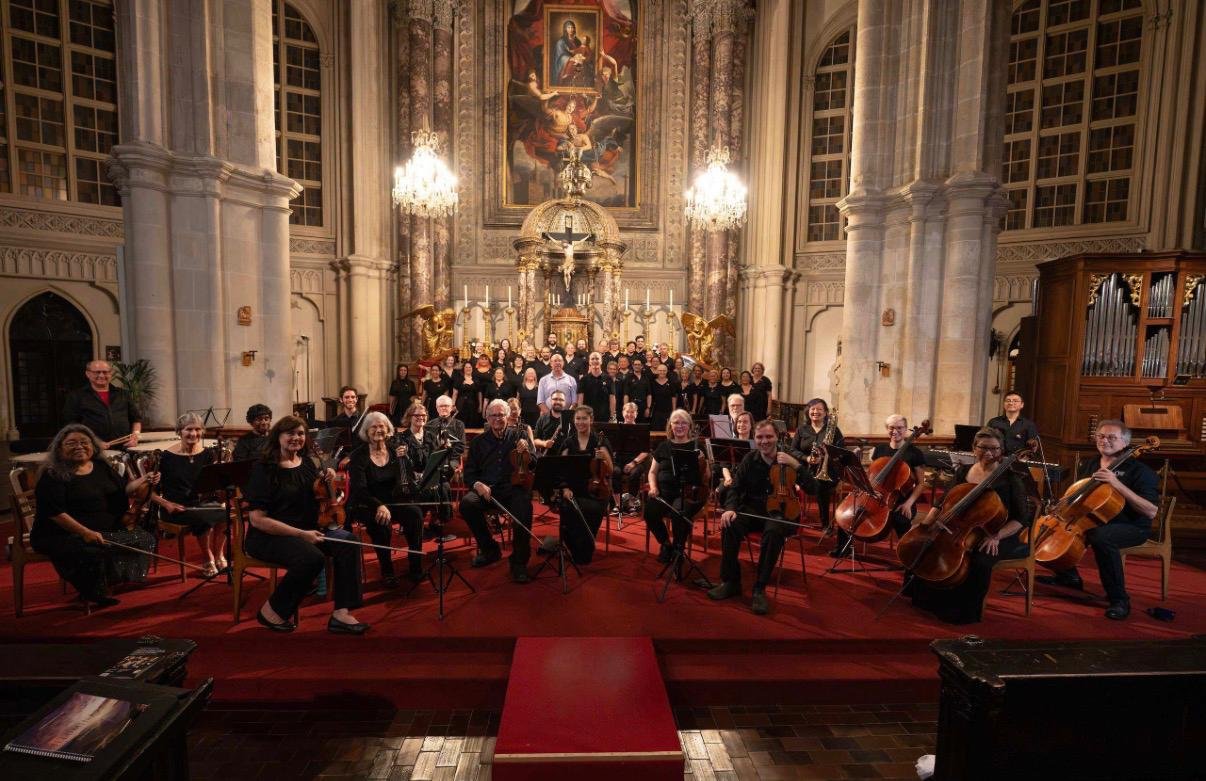
This reflection essay was written on the airplane on the way back from the GCC Music Department Tour. It is included as the Day 7 entry in my journal for the trip. Click here to see the full journal series with entries for all the days as well as numerous photos, audio, and the commemoration video prepared by one of the choir members. This essay also stands alone as a summary of my experience and is included here accordingly.
I am currently sitting on a Boeing 787 flying near the Hudson Bay in Canada, on my way from Amsterdam to Los Angeles returning from our Glendale Community College Music Department European Tour. For the past week or so, we’ve been exploring first Prague and then Vienna with members of the Symphony of the Verdugos, which is the GCC symphony orchestra, and the Concert Singers, the advanced choir for the college. We performed in one church in each of the two cities, and otherwise participated in a cultural tour of the region, steeped in classical music history that I have spent many years studying in music school and on my own.
It has been an amazing experience. I went to Ireland about 9 years ago, in June of 2017, participating in a cultural tour around the south of the country, fiddling my way from Dublin to Ennis by way of several other cities. I remember at the time thinking that it would be really cool someday to do a similar cultural tour for my classical music roots, maybe to some place like, say, Vienna. When the idea of this trip was first proposed to us last year, I jumped on the opportunity to fulfill that bucket list item. We only saw a tiny fraction of what there was to see, with only a few days in Vienna and only one in Prague. Some people were returning to one or both of these cities, but this was my first time anywhere in mainland Europe.
As a composer who recently earned his master’s degree in composition and who has been looking for opportunities to get his music performed, I also reached out to our conductor the day after that initial meeting in Spring 2025 to ask if I might be able to compose a piece for the tour. He said he had no objection, and we reconnected over the idea as it started to become more clear who all would be going on the trip. We wound up with a hybrid chamber orchestra, featuring chamber strings of 4 first violins, 5 second violins, 3 violas, 3 cellos, no basses (though there was one at one point), and then 3 flutes, 1 oboe, 1 clarinet (who could also play bassoon), one trombone (up until the week before the trip there were going to be 2 trombones and 1 trumpet), and timpani. It proved to be quite a challenge to compose a piece for this ensemble, as it is missing several important orchestral instruments and sections. I didn’t have bassoons (I chose to use clarinet), horns, bass trombone / tuba, or even string basses. I broke down and wrote a bass part for our local LA concert since we had them there, but even then I had to write in such a way that it wouldn’t be too badly missed on the trip. I think the piece turned out pretty well for the constraints I had, and it was fun to take on the challenge. This is a real composition issue, as you can only ever write for what you have. These days with things generally being standardized, you can get away with writing generically for ensemble types rather than specific groups, but certainly back in the day there were lots of stories of people writing things a certain way because they either had really strong players on a particular part, or because they didn’t (look into the performance history of Handel’s Messiah during his lifetime for a striking version of this). I will be rewriting this movement and adding two additional movements (in progress) for the Fall featuring the full orchestra for a performance in October.
The piece overall is called Musical Meditations, of which the movement we played on this trip will be the first movement, subtitled “Meditations on the Great ‘A’ of Life / Crosspicker’s Delight”. The other two movements are codenamed “Song of Peace” (started shortly after the war with Iran broke out) and “Dance”, though that one is probably going to be renamed. At least it’ll be “Dance of [something]”. I have recordings of this first movement from both concerts on the tour that I made with my Zoom H2 recorder, and I’ll be getting the recording from the GCC concert shortly after I get back. I’ll post at least one of them for your listening pleasure once I decide which one (or maybe two) I like the best, with more details then.
I am very excited to have had a piece of mine performed in Europe in any form, and I would like to sincerely thank Dr. Paul Sherman, our conductor, for allowing me this opportunity, and the orchestra for performing it with me! It means a lot coming from this group in particular, which is the group I’ve performed with the longest in my life (going on 14 years), and the group that has premiered the most pieces for me, with this being my third orchestral premiere with the Symphony of the Verdugos or its named predecessor, the Glendale College Community Orchestra.
One thing that was nice about this tour was a chance to get to know some people I’ve been playing with for multiple years but hadn’t really talked to much before, as well as some (especially in the choir) that I’d never really met at all. I’ve noticed that we rarely venture too far from our sections during rehearsals, a phenomenon I first really became aware of all the way back in my Berklee days, and which has remained true to this day. I know my section the best, the sections around me, and then a few people from other sections, mostly when I meet them in other contexts (other classes in college, or if they join me in another orchestra, or in my case when I write pieces people often start talking to me). Parties outside of rehearsal are another way to meet people, but we haven’t done one of those in a long time. I think I spent some quality time with everyone who came from the orchestra on this trip, and I even had a chance to meet some of the choir members who we’ve collaborated with several times but rarely socialized with.
My core group on this trip wound up being Joanna, one of the cello players who has sat next to me for several years (it turns out we’re both from suburban Chicago and around the same age, so we’ve become pretty good friends over the years), and Christine, a trombone player who I hadn’t previously talked to. The three of us did most of the activities together, and we were frequently joined by Ralph, our timpanist. Anyone who knows me today can attest that I love nerding out over a lot of topics, especially anything related to music, and this trip provided many opportunities to do that with the four of us (and some of the others). I can talk shop for as long as you’ll let me, at least for hours, so it was fun to have a chance to do that with new and old friends! I think my favorite was when we were sitting in a jazz club waiting for the show to start and talking about linguistics! I also had several chances to talk notation software and music theory, two of my other favorite topics 🙂
Pretty much all of the activities chosen for the trip by our tour company KI Concerts and our guides Chiara and Sebastian were excellent for a first-timer to the cities. It was a bit rough coming during what turned out to be a historic heat wave in Europe. Highs in the 90s and even up to about 102 at the peak didn’t help us explore, but we found places that were cool enough and we did have AC on our tour bus and in our hotels at least. My group chose to do a catacombs tour in Vienna to try to cool off (and because those are just interesting places to visit). We survived the heat and still managed to make something of our trip. The main thing that got crimped was random exploring during our free time, which was harder when it was 100 degrees outside. I brought my water bottle everywhere! Our first day in Prague was a bit much, with jet lag, a long walking tour (I logged 18,000 steps with my phone) followed by our first concert that night. It went pretty well for all that, but it would have gone better if we didn’t try to do all of that in one day, especially on the first full day. One thing that helped us was that we got there in the evening on Tuesday and did have a night of sleep before we did all of that.
Both of the cities we visited have famous rivers that run through them that have been the subject of pieces of music, the Vltava river (or Die Moldau in German) and the Danube in Vienna. I’ve played pieces about both of them in the past (Smetana’s “Vltava” from his suite Ma Vlast (My Homeland), or in German “Die Moldau” from Mein Faderland, and of course “Waltz on the Beautiful Blue Danube” by Johann Strauss II), and it was fun to get to see them in real life!
Other ways in which my classical music heritage came to life included visiting the central cemetery in Vienna (which is actually on the outskirts of the modern city, or fairly far from the historic city core), where we saw the current burial sites for Ludwig van Beethoven, Franz Schubert, Johannes Brahms, several Strausses, and even Arnold Schoenberg. We only got to see a fraction of the cemetery, as it’s huge and we didn’t have that much time. Our tour guide did tell us we were the first group she’s guided who knew who Arnold Schoenberg was 🙂
I also took an opportunity during my free time to go check out a historic musical instrument exhibit that Christine recommended to us. Several of us went there on Saturday. I wrote about it in some detail on that journal post, so I won’t rehash it all here, but that was one of my official goals I had for myself and I even had a chance to try playing an acoustic clavichord!
The food was also really good on this trip. I can be a picky eater (I was very picky as a kid, better today but still not great about that), so I’m often concerned about that in contexts like this where I don’t always have control over the food. But I didn’t have a single bad meal on this trip, either from food I knew about in advance or food I had never tried (or even heard of) before.
I could keep writing for a while yet, but since I did fairly detailed daily journal posts, I think I’ll finish this post with some words about the pieces we played for our concerts. We played my piece as the overture, and then the other orchestra-only piece was just the first movement from Mozart’s Symphony No. 38 in D Major, the “Prague” symphony (for obvious reasons). We then performed Haydn’s “Te Deum” with the choir. One fun fact about that piece is that we got to sit in the “Haydnsaal” at the Esterhazy estate in Eisenstadt, which is the hall where that piece was premiered in 1800. It would have been fun to play it there! The choir apparently did sing one of their songs in the hall (we were in separate tour groups for that event). Then the choir did three songs of their own, and we finished out with modern American composer Elaine Hagenberg’s “Illuminare” for choir and orchestra. I really like that piece. My favorite movement is probably the middle one, “Nox”, which feels to me like a mashup of Carmina Burana and “Duel of the Fates” from Star Wars Ep. 1 (Phantom Menace - the final lightsaber duel with Darth Maul). But all five movements are a lot of fun, and when we play it with proper sensitivity there’s a particularly beautiful moment in the fourth movement where there’s an alto solo in the choir that the orchestra accompanies very delicately. The violas match the alto at pitch on the melody, so we have to be especially careful as that’s low in the range of the singer and could very easily be covered. But it felt really good in the Vienna hall in particular last night, and I think we nailed that part. I haven’t listened to that part of the recording yet, but people in the audience have told me it worked.
That hall was incredible, the Minoritenkirche near the city core. It has extremely high ceilings and near cathedral levels of reverb. It was a great place to play our final concert and have our final event of the trip (much better than if we’d played there first and then played in the Prague venue - that one was fine, but not nearly as epic as in Vienna). We got a standing ovation in our concert last night, and at least from my seat as principal viola it basically felt excellent. I did listen to part of the recording last night to see how it turned out with the crazy reverb, and if I could dial it back slightly I would but I think it’s pretty good for the way I made the recording. My preference would be for some sort of multi-mic stereo array near the orchestra (and a separate array in front of the choir) and a couple of room mics farther back (and maybe even some spot mics if we’re really getting extravagant), but seeing as how I only had a little H2 and a chair to put it on, I think it worked!
We got back last night and had a party in the hotel lounge for several hours after our concert, before getting (or not) a tiny bit of sleep and then heading for the airport at 3 AM. I didn’t sleep at the hotel, but I have had a couple of hours of sleep on the plane before writing this entry. I’m looking forward to sleeping in my bed tonight! It’s been an incredible trip all around, but I am ready to be home again!
I would like to publicly thank Dr. Sherman and Dr. Peter Green (the choir director) for organizing this trip, Chiara and Sebastian for being our group guides throughout our stay, and all the people who came on the trip for making this such a memorable experience as a composer, as a musician, and just as a person!
I will post recordings sometime in the next couple of weeks, and maybe one more photo post if I can get a few photos that others took that they haven’t posted or sent me yet, but otherwise, I’m going to sign off here from an amazing experience, and here’s to many more years with all my friends, both old and new!
–Richard Bruner, June 2026